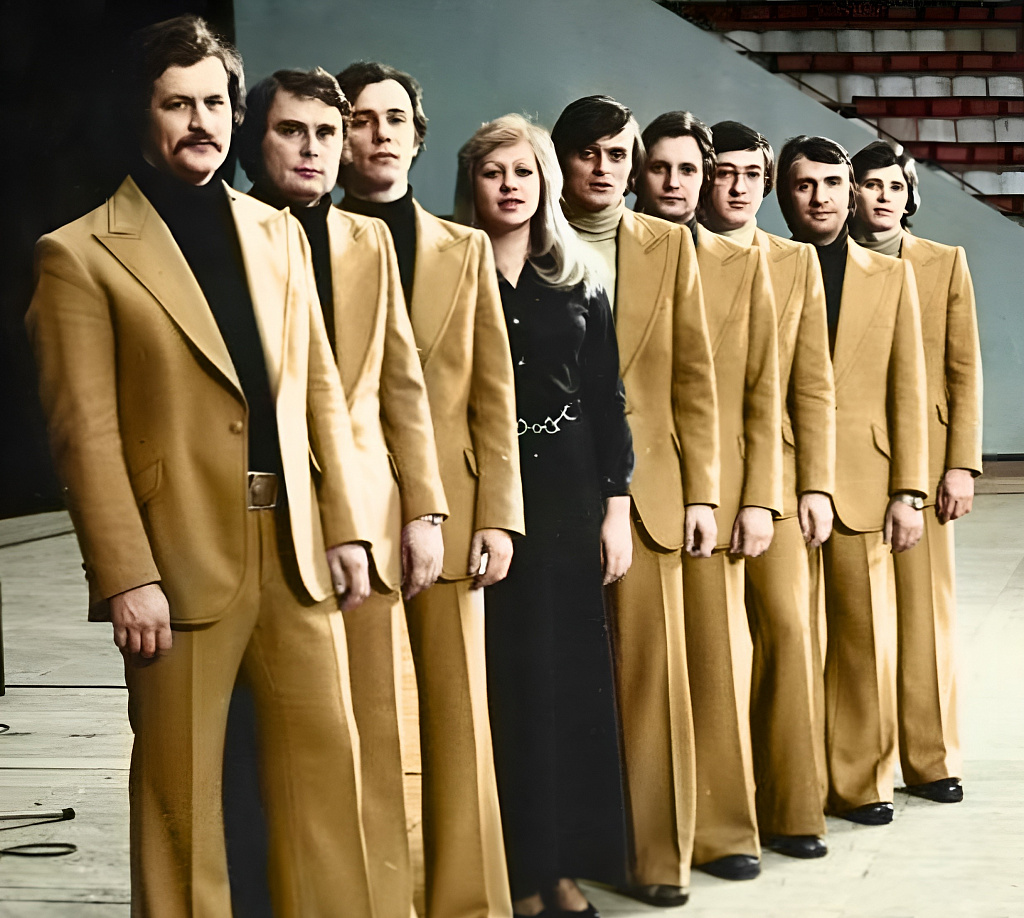
The vocal-instrumental ensemble Plamya ("Flame") was founded in October 1975. Its core lineup consisted of musicians who had left the ensemble Samotsvety ("Gems"). Nikolai Mikhaylov became the artistic director, while Sergey Berezin was appointed musical director and also came up with the name Plamya. During its first months, the ensemble performed at the Exhibition of Achievements of National Economy (VDNKh), and its early development was greatly supported by composer Mark Fradkin and singer Iosif Kobzon.
Before long, Plamya became one of the Soviet Union's most popular vocal-instrumental ensembles. Its repertoire featured songs by many of the country's leading composers and lyricists. Numerous compositions gained nationwide popularity and eventually became classics of Soviet pop music. The ensemble regularly appeared on television, participated in major national festivals, and toured extensively throughout the Soviet Union.
Over the years, the group's lineup changed many times. Some musicians left to join other ensembles, while new performers took their place. Despite these personnel changes, Plamya maintained its distinctive musical style, continued to perform successfully, recorded new songs, and collaborated with many of the era's most prominent songwriters and composers.
In the early 1980s, the ensemble sought to broaden its artistic horizons by experimenting with more sophisticated musical material. Alongside its traditional pop repertoire, the group incorporated elements of rock and jazz-rock into its performances. One of its most ambitious projects was the musical and poetic composition Kinematograf ("Cinema"), based on a work by Yuri Levitansky and later released as a standalone album. Although the project received positive critical acclaim, it did not achieve the same level of popularity among the general public as the ensemble's more familiar hits.
In 1982, Plamya toured Afghanistan. During one of the trips, the musicians' bus came under fire, although none of the ensemble members were injured. Footage recorded during the tour was later used in the production of the documentary film Plamya Afgana ("The Flame of Afghanistan").
That same year, the ensemble participated in the first youth television bridge between the Soviet Union and the United States, titled Moscow - Space - California. Together with other Soviet performers, the musicians presented several of their songs, becoming part of one of the most significant international television projects of its time.
By the late 1980s, public interest in Soviet vocal-instrumental ensembles had begun to decline. In 1990, Plamya effectively ceased to exist in its classic form. Nevertheless, the ensemble's songs continue to be performed, and various groups using the name Plamya or carrying on its traditions still appear in concert, preserving the musical legacy of one of the Soviet Union's most renowned vocal-instrumental ensembles.