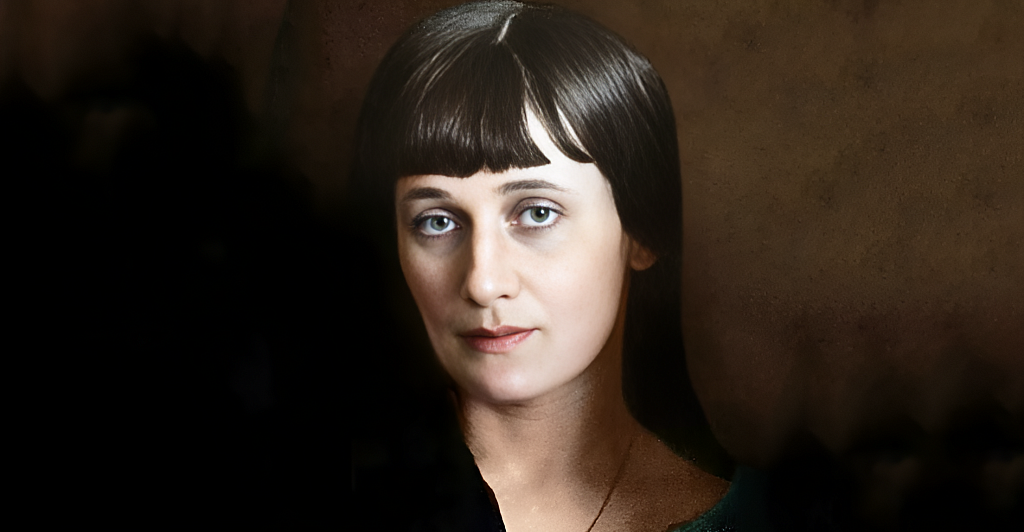
Anna Andreyevna Akhmatova (real name — Gorenko; after her first marriage, she used the pseudonym Gorenko‑Gumilyov; after the divorce, she adopted the name Akhmatova; after her second marriage, she used the name Akhmatova‑Shileyko; after the divorce, she returned to the name Akhmatova; born on June 11 [23], 1889, in Odessa, Kherson Governorate, Russian Empire; died on March 5, 1966, in Domodedovo, Moscow Oblast, RSFSR, USSR) was an outstanding Russian and Soviet poetess. She became a member of the Union of Writers of the USSR in 1939 and was nominated for the Nobel Prize in Literature twice — in 1965 and 1966.
Akhmatova, recognized as a classic of Russian poetry, faced censorship, bans, and persecution. The 1946 resolution of the Central Committee of the All‑Union Communist Party (Bolsheviks) restricting her work was not revoked during her lifetime, and many of her works were not published in her homeland either during the author’s lifetime or in the following decades. Nevertheless, Akhmatova’s name was surrounded by fame among poetry connoisseurs both in the USSR and abroad.
One of Akhmatova’s most significant works was the poem “Requiem,” dedicated to the suffering of the wives and mothers of “enemies of the people.” The first chapters were written in 1934–1935, the subsequent ones in 1936–1943, and the final chapters were refined over the course of twenty years after Akhmatova was expelled from the Union of Writers of the USSR. The poem was circulated in samizdat for a long time and was only published in the mid‑1980s.
Biography
Anna Andreyevna Gorenko (later known as Akhmatova) was born in the Odessa district of Bolshoy Fontan into the family of Andrey Antonovich Gorenko, a hereditary nobleman and naval mechanical engineer, who, after moving to the capital, became a collegiate assessor and a state control official. She was the third of six children. Her mother, Inna Erazmovna Stogova, was distantly related to the poetess Anna Bunina. Akhmatova wrote:
In the family, as far as the eye can see, no one wrote poetry; only the first Russian poetess, Anna Bunina, was the aunt of my grandfather, Erazm Ivanovich Stogov…
The surname Akhmatova was chosen in honor of her great‑grandmother, Anna Egorovna Motovilova, the daughter of Egor Nikolaevich Motovilov, the wife of Praskovya Fedoseevna Akhmatova. Anna Gorenko adopted this surname as her literary pseudonym, creating the image of a “Tatar grandmother,” supposedly descended from the Horde khan Akhmat. This choice was influenced by Anna’s father, who, upon learning about her poetic endeavors, asked her not to bring shame upon the family.
In 1890, the family moved to Pavlovsk, and then to Tsarskoye Selo, where in 1899 Akhmatova enrolled in the Mariinsky Women’s Gymnasium. She spent her summers near Sevastopol, where she earned the nickname “wild girl” for her unusual behavior:
I got the nickname “wild girl” because I walked barefoot, wandered around without a hat, etc., jumped out of boats into the open sea, swam during storms, and got so tanned that my skin peeled off, and all of this shocked the provincial young ladies of Sevastopol.
Akhmatova recalled her childhood years in Tsarskoye Selo:
My first memories are of Tsarskoye Selo: the green, damp parks, the pasture where my nanny took me, the racetrack where little motley horses galloped, the old station, and much more that later found their way into “The Tsarskoye Selo Ode.” Every summer I spent time near Sevastopol, on the shore of Streletskaya Bay, and I became friends with the sea. The most powerful impression from those years was the ancient Chersonesus, near which we lived. A. Akhmatova. Briefly about myself.
Akhmatova learned to read using Leo Tolstoy’s alphabet, and at the age of five, by listening to the older children’s lessons, she learned to speak French. In St. Petersburg, she lived through the era associated with Pushkin and remembered the city before the advent of trams:
“Tram‑less, horse‑drawn, horse‑and‑carriage, cart‑driven, cart‑tram, rumbling and screeching, covered from head to toe in signs,” — this is how she described St. Petersburg. As N. Struve wrote, “The last great representative of the great Russian noble culture, Anna Akhmatova absorbed all of this culture and transformed it into music.”
She published her first poems in 1911 (“New Life,” “Gaudeamus,” “Apollo”, “Russian Thought”). In her youth, she aligned herself with the Acmeists (collections “Evening,” 1912, “Rosary,” 1914). The characteristic features of Akhmatova’s work include fidelity to the moral foundations of existence, a subtle understanding of the psychology of feeling, an interpretation of the nationwide tragedies of the 20th century in conjunction with personal experiences, and a tendency towards a classical style of poetic language.