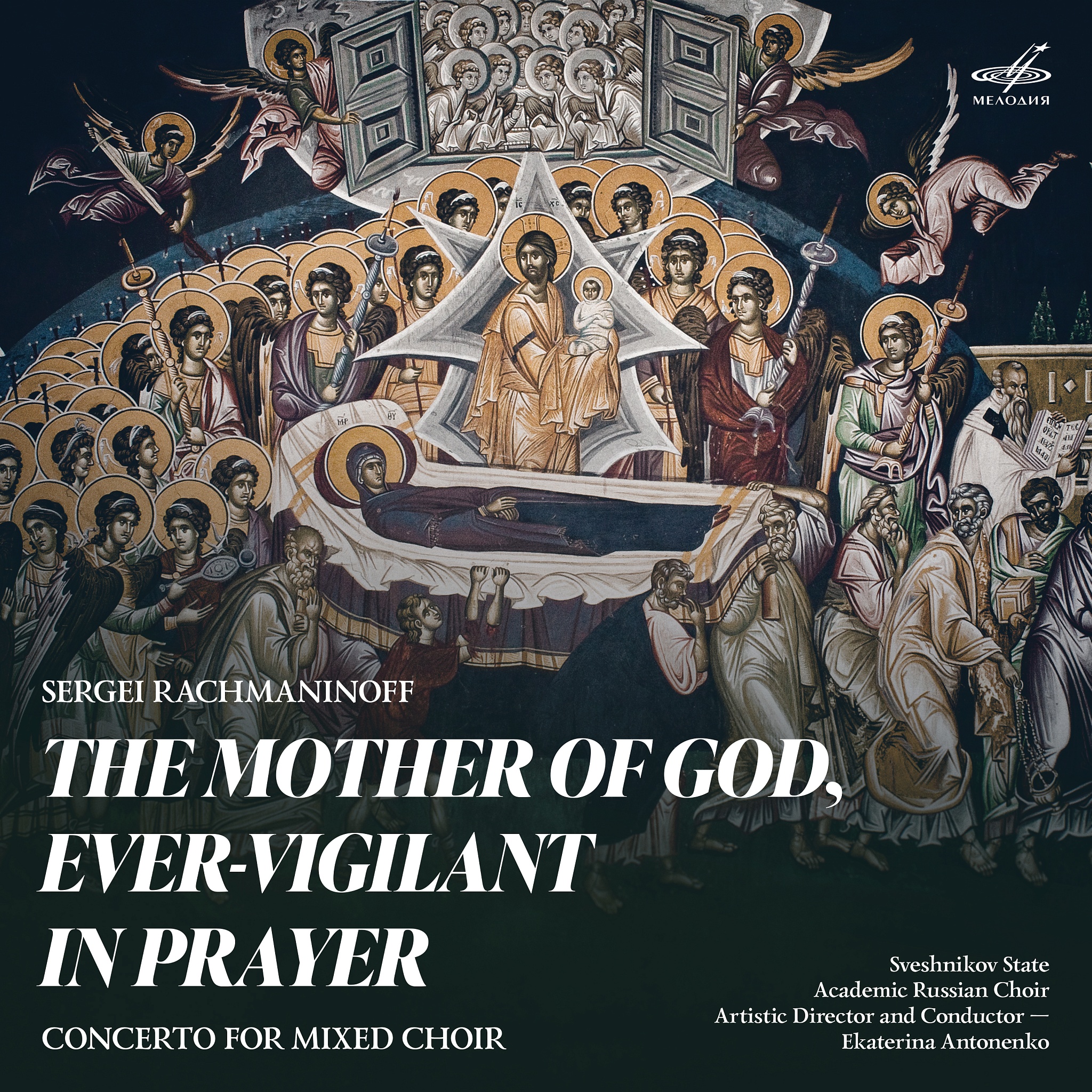
The turn of the 19th century saw a period of great growth for Russian sacred music. During this time, a new domain emerged at the Moscow Synodal School of Church Singing, producing a wealth of inspired liturgical chants, including the sacred works of the great Russian composer Sergei Rachmaninoff (1873–1943). His major choral cycles, the Liturgy of St. John Chrysostom (1909) and, in particular, the All-Night Vigil (1915), were recognized by his contemporaries as a brilliant culmination in the development of the Synodal School and of Orthodox musical culture as a whole. Rachmaninoff succeeded in blending an original artistic vision with a steadfast adherence to the liturgical style and the true spirit of church chant.
Rachmaninoff’s creative journey in this field began in 1893, shortly after he graduated from the conservatory, when he composed the concerto The Mother of God, Ever-vigilant in Prayer. The work is based on the text of the kontakion for the Dormition of the Most Holy Mother of God, a holiday that concludes the liturgical year in late summer (August 28, or August 14 according to the Julian сalendar):
“Neither the tomb nor death could hold the Mother of God,
who is constant in prayer and our firm hope
in her intercessions (for the world).
For as the Mother of Life, she was translated to life
by the One who dwelt within her ever-virgin womb.”
The “Dormition” refers to the peaceful passing of the Mother of God, a departure that is similar to sleep. The kontakion describes the Mother of God as an ever-vigilant Intercessor and advocate for humanity before God, one whom even death could not hold.
Rachmaninoff masterfully transforms this short yet profoundly rich text into music. The concerto format allows the composer to present contrasting musical themes and develop them in depth, while taking full advantage of the potential offered by choral singing. Rooted in folk and liturgical traditions, Rachmaninoff’s melodies speak directly to the listener, not just through the ears, but through the heart. Dynamics serve as a vital expressive tool, reaching extreme limits, from an almost ineffable silence of a quadruple piano to a powerful quadruple forte.
The brief introduction sounds calm and detached. The melodic motion seems to stand still. From a deeply intimate prayer – ppp (triple piano) – a short melodic motif emerges, which is pensively repeated first by the sopranos and later by the basses. Against this backdrop, a theme appears that resembles a sad lullaby, with a typical rocking motion. The lulling gradually evolves into an insistent plea as an expression of trust and hope for the intercession of the Holy Virgin. It is worth noting that Rachmaninoff adds a phrase that is not found in the canonical text: “intercessions for the world.” At this point, the melody surges into its highest register, marked fortissimo (very loud).
Then the wave of tension subsides, only to be followed by a new surge, accompanied by the words “neither the tomb nor death could hold the Mother of God” (the third line in the Russian version). The music in this section takes on a march-like quality. Rising in successive steps, it reaches a climax that is both stern and solemn, in which one can hear the heavy tolling of bells, followed by a long, sustained chant imbued with the intonations of a lament.
A brief fugato (“For as the Mother of Life”) serves as a traditional feature of the choral concerto, with each vocal part entering in turn, carrying a smoothly ascending theme. In the final section (“by the One who dwelt within her ever-virgin womb”), according to conductor Ekaterina Antonenko, “a wave of joy washes over us, initially like the resounding peal of bells, marked at a dynamic level ranging from double to quadruple forte, followed by an echo: the rhythmic phrases return, barely audible, at the ppp level. It is a quiet joy that our hearts beat to, a connection underscored by Rachmaninoff’s instruction – ‘strictly in time.’”
Rachmaninoff’s first sacred work was performed by the Synodal Choir, led by the distinguished Russian choirmaster Vasily Orlov, on December 12, 1893, during a concert held in memory of Pyotr Tchaikovsky. The finest Moscow sacred choir, with a perfect balance of vocal parts, meticulously calibrated dynamics, precise intonation, and rhythmic clarity, brilliantly rose to the complex challenge, presenting the audience with a program of contemporary sacred compositions.
Critics could not help but appreciate Rachmaninoff’s innovation, describing it as an “extremely beautiful work by the talented young composer.” Even today, listeners continue to be captivated by the melodic beauty of the concerto, the masterful choral writing, and the sublime and spiritual nature of the music. The work has become an integral part of Russia’s rich spiritual heritage.
Natalia Plotnikova,
Doctor of Art Studies,
Professor at the Moscow State Tchaikovsky Conservatory
* * *
The history of the ensemble dates back to 1936, when two major national institutions were established in Moscow: the State Symphony Orchestra and the State Choral Chapel, which later became the USSR State Choir. The ensemble’s first Artistic Director was Nikolai Danilin, the most authoritative choral conductor of his time. The last choirmaster of the Moscow Synodal Choir, Danilin was the first conductor to perform Sergei Rachmaninoff’s choral masterpieces Liturgy of St. John Chrysostom and All-Night Vigil.
Danilin conducted the ensemble’s first competitive audition. The choir was also joined by singers from the All-Union Radio Choral Chapel, founded by Alexander Sveshnikov in 1928. As Danilin simultaneously served as Artistic Director of the Leningrad Choral Chapel, the ensemble’s first concert took place on February 26, 1937, in the Hall of Columns of the House of Unions, conducted by Alexander Sveshnikov.
Soon afterwards, the leadership of the country’s leading choral ensembles was reshuffled: Sveshnikov was transferred to the Leningrad Choral Chapel, while Danilin became Artistic Director of the State Choir, a position he held for the following two seasons.
From 1941 to 1980, the choir was led by Alexander Sveshnikov, one of the most influential figures in Soviet choral music. In 1942, the ensemble was renamed the State Russian Song Choir. During the Great Patriotic War, the choir gave dozens of concerts both on the home front and for military units, performing in cities immediately after their liberation. In 1945, the State Choir performed for Soviet Army troops in Berlin, Prague, Vienna, and Budapest. In 1955, the ensemble was renamed once again, becoming the USSR State Academic Russian Choir.
During Alexander Sveshnikov’s tenure, the State Choir was distinguished by an exceptionally broad repertoire. Dmitri Shostakovich, Georgy Sviridov, Rodion Shchedrin, and other leading Soviet composers entrusted the choir with the premieres of their works. Alongside arrangements of folk songs and works by Russian and Soviet composers, Western European music held an important place in the ensemble’s repertoire.
In the post-war years, the choir’s repertoire expanded to include works by Renaissance masters Palestrina and Lassus, as well as music by Baroque composers including Monteverdi, Bach, Handel, Vivaldi, Jommelli, and Lotti. In the 1970s, the State Choir performed Bach’s Mass in B minor under the direction of Helmuth Rilling.
Among the ensemble’s extensive archive of recordings, a special place is occupied by the 1965 recording of Sergei Rachmaninoff’s All-Night Vigil.
Following the death of Alexander Sveshnikov, the legendary choir was led by a succession of distinguished choral conductors: Igor Agafonnikov (1980–1987), Vladimir Minin (1987–1990), Evgeny Tytianко (1991–1995), Igor Raevsky (1995–2007), Boris Tevlin (2008–2012), Evgeny Volkov (2012–2019), and Gennady Dmitryak (2020–2024). Since the 2024/25 season, the ensemble has been led by Ekaterina Antonenko.
The State Choir has participated in major national events and significant musical celebrations at the highest level. The ensemble took part in commemorations of the Victory in the Great Patriotic War and the Millennium of the Baptism of Rus’. Today, the choir regularly participates in the Days of Slavic Writing and Culture, the Moscow Easter Festival, and other major cultural events.
The State Choir presents solo programs at the country’s leading concert venues and collaborates with Russia’s foremost orchestras. The ensemble has performed with many outstanding conductors of our time, including Christoph Eschenbach, Teodor Currentzis, Valery Gergiev, Vladimir Fedoseev, Yuri Simonov, Mikhail Pletnev, Vladimir Jurowski, Alexander Sladkovsky, and Alexander Rudin.

