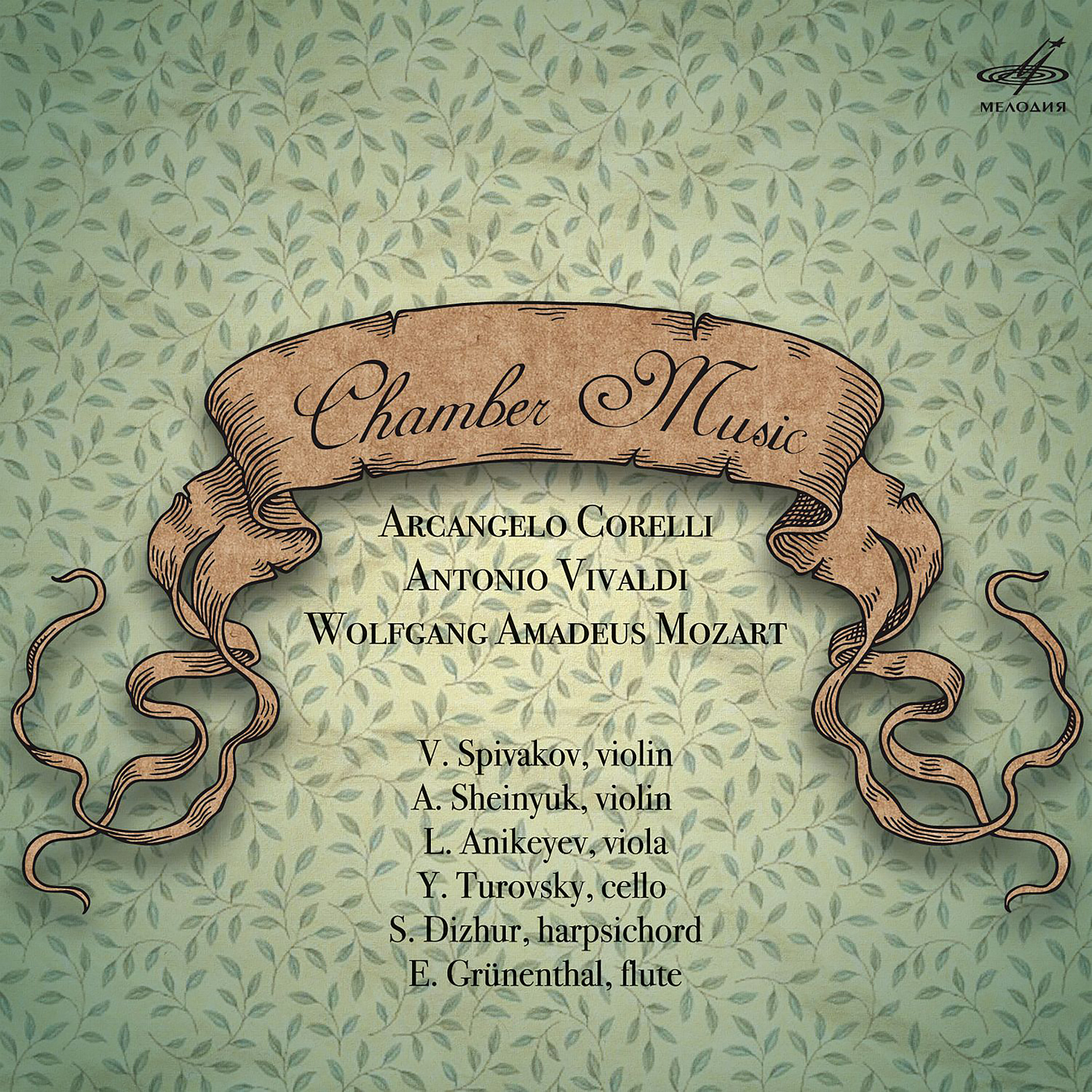
The names of the composers whose works are featured on this album come from different periods of the world music culture. Each of them is a great artist of his time and one of the heights in the historical process of art's development.
Arcangelo Corelli (1653 – 1713) was a remarkable violinist and composer, the founder of the Roman violin school who devised the classical fundamentals of the style and technique of violin playing. Corelli's artistic legacy is quite extensive. Unlike most of his contemporaries, the composer worked within the sphere of instrumental genres. He composed numerous orchestral соncerti grossi, violin and basso continuo sonatas, and trio sonatas. Both in orchestral and ensemble music, he showed his worth as a prominent connoisseur of the violin's richest capabilities.
The famous Italian Antonio Vivaldi (1678 – 1741) infamously said, "I can write a concerto faster than a copyist writes out the orchestral voices!" A striking quickness and ease of Vivaldi's composing process was an organic element of the composer's enormous professionalism he conquered the world of music with.
The artistic legacy of Wolfgang Amadeus Mozart (1756 – 1791) is unbounded indeed. His contribution to all music genres can never be overestimated. It is impossible to name a theatre company, a solo player, a vocalist, a choir, a symphony orchestra or a chamber ensemble that has never performed Mozart's masterpieces.
The lineup of the quartet performing the compositions by Corelli and Vivaldi is Vladimir Spivakov (1st violin), Anatoly Sheinyuk (2nd violin), Yuli Turovsky (cello) and Sergey Dizhur (organ/harpsichord). The ensemble demonstrates brilliant mastery with their diverse and colourful playing. All the performers have a very deep and precise sense of the music's stylistic subtlety and emotional nuances. In Mozart's quartet, the flute part was wonderfully performed by Eberhart Grünenthal, Germany, and the viola part by Lev Anikeyev.

