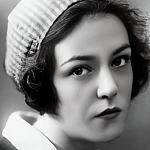
Veronika Mikhailovna Tushnova (1911, Kazan – 1965, Moscow) was an outstanding Russian Soviet poet and translator, known for her lyrical works about love. She was a member of the USSR Writers' Union since 1946. Such popular songs as "They don't give up loving", "You know, everything will still be!.." and "One Hundred hours of Happiness" were created on her poems.
In 2015, the Russian Reporter magazine conducted a study in which it compiled a list of the most popular poetic lines in Russia. The poem "One does not renounce loving" took 36th place in this top 100.
Tushnova was born in Kazan in the family of a scientist. Her father, Mikhail Pavlovich Tushnov, was a professor at the Kazan Veterinary Institute, and her mother, Alexandra Georgievna Postnikova, graduated from the Higher Women's Bestuzhev Courses. The family lived in different places, but the memory of her hometown and the Volga River has always remained important to Veronika.
In 1928, Tushnova graduated from school No. 14 named after A. N. Radishchev in Kazan, where her literary abilities were noticed by literature teacher Boris Nikolaevich Skvortsov. Despite her father's desire to see her as a doctor, she enrolled at the medical faculty of Kazan University.
After the family moved to Leningrad in 1931, Tushnova continued her studies at the medical institute. Soon they moved to Moscow, where his father got an apartment on Novinsky Boulevard. In the capital, Veronika began to study painting and became seriously interested in poetry. In 1938, she married psychiatrist Yuri Rozinsky, and in the same year her first poems were published.
In 1941, on the advice of Vera Inber, Tushnova entered the Gorky Literary Institute, but the outbreak of World War II changed her plans. Together with her mother and young daughter Natasha, she evacuated to Kazan and worked as a ward doctor at a neurosurgical hospital for wounded soldiers of the Red Army. In 1943, she returned to Moscow and worked as a resident physician at the hospital.
Tushnova's first collection of poetry, The First Book, was published in 1945. In 1947, she participated in the first All-Union Meeting of Young Writers.
The second collection, Paths and Roads, was published in 1954, and in the last years of her life, Tushnova created such works as Memory of the Heart (1958) and One Hundred Hours of Happiness (1965), where she reflected on love and human relationships.
Tushnova also led a creative seminar at the Gorky Literary Institute, worked as a reviewer at the Fiction publishing house and translated works from Bengali and Tatar. She was friends with the Serbian poet Desanka Maksimovic and dedicated original poems to her.
One of Tushnova's most famous works was the poem "They do not Renounce loving," written in 1944. The romance to this music, first performed in 1976, became a hit in 1977 thanks to the performance of Alla Pugacheva, who called this song the main one in her repertoire.
In the spring of 1965, Tushnova became seriously ill and was hospitalized. She died on July 7, 1965 in Moscow from cancer and was buried at the Vagankovo cemetery with her parents.