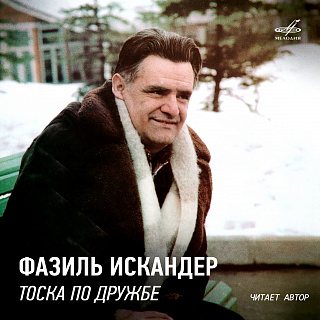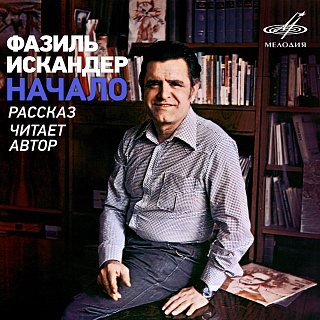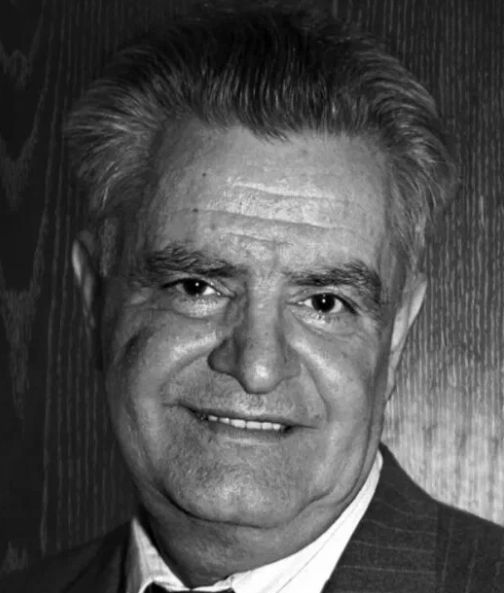
Fazil Abdulovich Iskander (1929, Sukhum, USSR — 2016, Peredelkino, Russia) was a prominent Soviet and Russian writer, journalist, poet, screenwriter, and public figure. He was a member of the Union of Writers of the USSR since 1957. From 1986 to 1991, he served on the Central Audit Commission of the Union of Writers, and in 1991, he became a co-chairman of the Secretariat of the Union of Writers of the USSR. He was also a People's Deputy of the USSR from the Abkhaz Autonomous Soviet Socialist Republic (1989-1992) and a member of various commissions, including the Commission on State Prizes of Russia, Human Rights, and Pardons under the President of the Russian Federation, as well as the Presidential Council on Culture and the Arts. In 1995, he became a full member of the Russian Academy of Natural Sciences, the Academy of Russian Art, and the Independent Academy of Aesthetics and the Free Arts. He was also an honorary doctor of Norwich University (USA) and a member and recipient of the Bavarian Academy of Fine Arts (Germany).
Fazil Iskander was born into a Persian and an Abkhazian family. His father was deported from the USSR in 1938. In 1947, he graduated from a Russian school in Sukhum with a gold medal and enrolled in the Moscow Library Institute. In 1951, he transferred to the Maxim Gorky Literature Institute, which he graduated from in 1954. He then worked for newspapers in Kursk and Voronezh, and in 1956 returned to Sukhum, where he worked as an editor for the Abkhaz branch of the State Publishing House. Since 1962, after his marriage, he has lived permanently in Moscow.
Iskander's creative career began with poetry, with his first poems appearing in 1952, and his first prose publication in 1956 in the magazine "Pioneer." In 1957, his first poetry collection, "Mountain Paths," was published in Sukhum. In 1962, two of his short stories were published in the magazine "Yunost." Iskander also contributed to the magazines "Literaturnaya Abkhaziya," "Novy Mir," and "Nedelya." In 1966, his debut novel, "The Constellation of Kozlotur," was published in the magazine "Novy Mir" and gained recognition in the literary community. In 1979, he participated in the Metropol anthology published in the United States, which led to a period of limited publication of his works until the mid-1980s. However, with the onset of Perestroika, his books began to be actively published, and during this period, he produced significant works such as the philosophical tale "Rabbits and Boas" (1987) and the epic novel "Sandro from Chegem" (1989). In the 1990s, a four-volume and a six-volume collection of the writer's works were published. In the early 2000s, new books such as "Night Carriage" and "Where the Dog Is Buried" were released, as well as a ten-volume collection of his works. His works have been adapted for film and stage productions on numerous occasions.
Fazil Iskander's writing is characterized by a seamless blend of prose and poetry, evident in his recurring themes, interconnected narratives, and a keen focus on moral content. The action of his works is mainly set in Abkhazia (Mukhus-Sukhumi, Chegem). The writer himself called himself "an unquestionably Russian writer who glorified Abkhazia." His works combine humor, ranging from lighthearted to sad irony and bitter sarcasm, with drama and tragedy. In his prose, Christian motifs are intertwined with national mythology and epic through the stylization of Abkhazian fairy tales and legends. Iskander's essays are characterized by their parable-like and aphoristic nature.
Fazil Iskander was awarded numerous state awards in Russia and Abkhazia, including the USSR State Prize (1989) and the Russian Federation State Prize (1993). He also received the A. D. Sakharov Prize for Courage in Literature (1991), the Pushkin Prize from the A. Tepfer Foundation (1992), the Golden Ostap and Triumph Prizes (1998), the Russian Academy of Sciences' commemorative medal "Masterpieces of Russian Literature of the 20th Century" (2003), and others. In 2011, he was awarded the L. N. Tolstoy Yasnaya Polyana Literary Prize and the Russian Government Prize for his collection of Selected Works. He was twice nominated for the Nobel Prize in Literature: in 2012 by the Moscow Writers' Union and in 2013 by the writer Andrei Bitov.